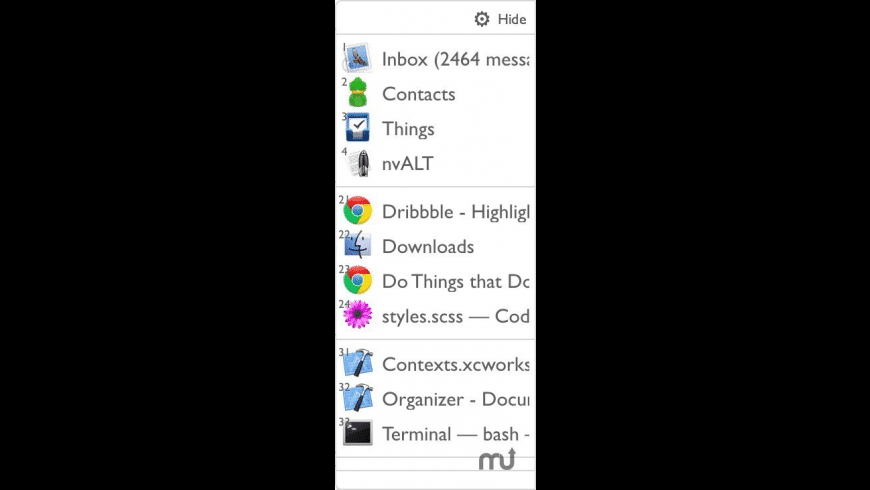
Contexts 3 4 1 – Fast Window Switcher Panel
- Nilight 3 Gang Aluminum Rocker Switch Panel 5 Pin ON/Off Pre-Wired Toggle Switch Panel With Rocker Switch Holder 12/24V for Marine Boat Car ATV UTV,2 Years Warranty 4.6 out of 5 stars 150 $17.81.
- Dubbed Windows Flip 3D at the time, it provided a neat effect that utilized Vista's hardware acceleration capabilities. Windows Flip 3D disappeared in Windows 8 and was replaced by Switcher and the new edge swipe interfaces. So if you hold down WINKEY and tap TAB, the Switcher UI pops up on the left edge of the screen.
- Contexts 3 4 1 – Fast Window Switcher Panel Installation
- Contexts 3 4 1 – Fast Window Switcher Panel Drug Screen
License changed to LGPL 3.0. 1.4 Added the DroppedDown property, and the DropDown, DropDownClosed events to the PopupComboBox class. Fixed resizing of a popup when the MaximumSize property of the content control is not set. 1.3.1 Tab-key properly transfers the focus between controls contained in a popup window. Make Windows 7 Start Menu Search Find Your Applications Faster. Make the “New” Menu Open Faster. If you’ve ever used the New menu from the Windows context menu, you’ve probably noticed that it’s not always as fast as it could be. Here’s how to make it faster by cleaning it up. Contexts for mac is a competitor to Witch. As a long-time non-mac user looking for more intuitive window switching, I really like this app. It allows for switching between all the windows you have open, using your keyboard or your mouse. There's also an optional side panel, which is.
Today, we are releasing Contexts 3, the biggest update to Contexts ever! It comes with a much improved search, options for grouping and filtering windows by Space and a lot more.
Before we go into the details, one important change to note is that Preferences are now accessed by relaunching the app; the “Pref.” buttons have been removed.
Lets look at the 4 most important enhancements first:
Search has been dramatically improved and lets you switch to your windows in as few as two or three keystrokes. Yes, you are reading it right! Here is how it works (for more details visit the website):
- Search matches non-consecutive characters. Up to one typing mistake is ignored too.
- Character matches at start of app names and window titles get a higher score allowing you to just use acronyms to get to specific windows. E.g. “fd” for a Finder window with title “Documents” and “fw” for a Finder window with title “Work”.
- Once you type a search query and select a window from the results, typing the same search query next time will cause that window to be the first result. E.g., if you type “m” and the first two results are “Mail” and “Messages” in that order, select the second result “Messages” with the arrow keys and the next time you search “m”, “Messages” will be the first result.
- If you want to go even faster, use Fast Search: just hold down the Fn key and start typing your search query; the panel will appear and your results will be shown; select a window and release Fn to activate it. E.g. to switch to Safari press Fn-S, to switch to Messages press Fn-ME and so on. It is fast and effortless. You can pick the modifier key you prefer or disable this if you want to from Preferences > Search.
If you use Number Switching, we highly recommend you try out Fast Search. It is as fast, way easier (to remember a character or two from the title than an arbitrary number), and better at remembering mappings across app restarts.
Command-Tab Switcher is now a lot more configurable. First, it can be set to show windows from all Spaces or only from visible Spaces. Second, minimised windows, hidden windows, and apps without windows can all be individually set to show, not show or show at the bottom of the list.
Also Command-Tab keyboard shortcut and Option-Tab keyboard shortcut can have their own set of settings.
Windows are now grouped by Space and ordered alphabetically by app name on Sidebar, Gesture Switcher and Number Switcher. The Sidebar can also be set to show windows from all Spaces, only from visible Spaces or if you are using multiple displays only those which are on the display a Sidebar is on.
The existing grouping behaviour is still available in case you use Number Switching or just prefer it. See Preferences > General to change back to it.
- If you are using multiple displays, Contexts can show the Panel on all displays simultaneously. You no longer have to turn your head to look for your window switcher on another display.
Besides the major enhancements mentioned above, the following improvements and refinements have also been made in this release:
- The app has a new icon.
- The appearance has been considerably refined.
- When the Sidebar is configured to be on the left side of the display, the app icons are now shown on the left of the title like they are otherwise.
- A menu has been added to the Sidebar which can be used to adjust some important preferences. The Hide button has also been moved into it.
- Adjustments have been made to the positioning of the Panel.
- You can optionally start a search from the Command-Tab switcher just by typing a query while holding down Command or Option. When this is enabled, you can press & hold Command-Q, Command-W etc to perform the corresponding actions.
- “Auto adjust window widths so they are not overlapped by Sidebar” preference is now enabled by default.
- “When cursor not over” preference has been changed from a slider to much clearer named options.
- Number Switcher shortcuts are disabled by default. Also “Show Numbers on Sidebar” preference has been moved to Number Switcher preferences and is now disabled by default.
- Some cross platform apps (and others written using third-party frameworks) have issues with the setting “When switching to an app, perform Dock icon action”. This setting is now disabled by default. If you enable it and have issues switching to any apps, please let us know so that we can add an exception for those apps.
- Single finger gesture is no longer available.
- Some preferences have been reorganised.
- The welcome window which has details about how to give Contexts accessibility access has been refined.
If you have any questions or feedback, you can get in touch with us at hello@contexts.co and twitter.com/contextsapp. We love to hear what you think!
When you are working in Windows, the Windows right-click context menu is a very useful tool, offering you context sensitive relevant options to facilitate the task you are working on.
During the regular course of your work, if you find yourself accessing the Windows Control Panel more often than usual, why not include this feature in your Windows right-click context menu, where you can get to it very quickly?
No doubt the settings window or interface has taken over most of the tasks that the control panel does, but the control panel is a still a tool that most Windows users would like to continue using.
The Windows Right-Click Context Menu
If you check the defaultWindows right-click context menu it has the options of view, sort by, refresh, and so on until new, display settings and personalize. Some of these options have sub-menu’s to further expand on the option you select. From this Windows right-click context menu, how do you go about adding the all-important Control Panel?
Manually Adding the Control Panel
You can edit the registry manually to add the control panel to the context menu, by making a couple of quick edits in the Windows registry.
Before you start this process, it is strongly suggested to backup your computer and your registry, before you make any changes to the registry. You probably want to read relevant information on how to use the registry editor as it a very powerful tool that if used incorrectly, can render your computer inoperable or unstable.
Contexts 3 4 1 – Fast Window Switcher Panel Installation
Click on Start and type “regedit” to open the registry editor. Press the enter key and click on yes to permit the editor to make changes to your PC.
Use the sidebar in the registry editor to navigate to the key “HKEY_CLASSES_ROOTDirectoryBackgroundshell”.
Now, to create a new key inside the shell key, right-click the shell key and choose New followed by Key, and type in the new name as Control Panel, for the context menu.
Next, right-click the control panel key and select New followed by Key and type in the name of the new command key.
Double click on the default value on the right side of the screen with the new command key selected on the left side of the screen and its properties window will now open.
Type “rundll32.exe shell32.dll, Control_RunDLL” into the input box for value data and then click OK.
Contexts 3 4 1 – Fast Window Switcher Panel Drug Screen
You will now be able to test your Windows right-click context menu as changes are saved immediately. Just right click anywhere on your computer’s desktop screen or in your file explorer and confirm that you can now see the “Control Panel” option added.
Conclusion
This way, you will find it easy to include the control panel option to your Windows right-click context menu. The interesting thing is that you can test your new option immediately on adding it!
You are very strongly advised to backup your computer, including your registry before you attempt in manually editing it to add any additional option to your Windows right-click context menu.