Calendarpro 2 4 – Google Calendar Application
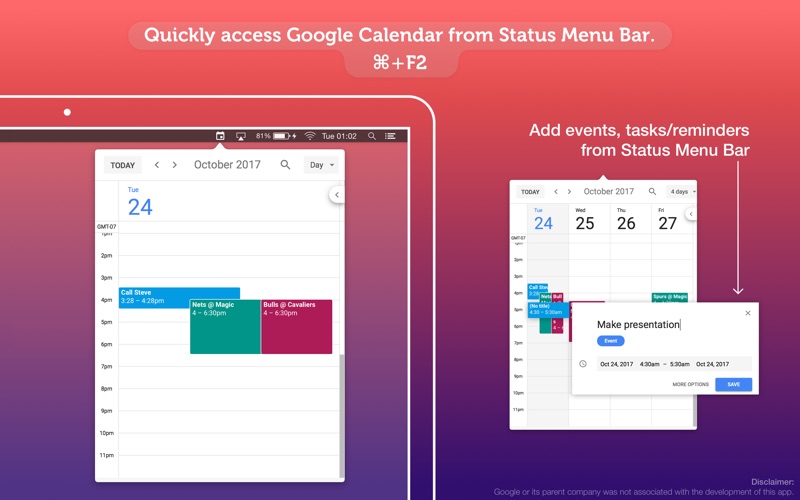
🏆 Included in 'The Essential Android Apps for 2018' list of the popular Lifehacker weblog. Business Calendar 2 has everything you need in a calendar app: It provides an excellent overview of your appointments, it’s easy to use and it gives you powerful tools for planning and scheduling your events and tasks. 🎯 Your Personal Organizer calendar, schedule planner and task organizer in one. Use google Chrome - Google Apps (9 dots in a square) - you should see google gmail, google calendar etc. right click on desired google tool - open in new window. Once opened in a new window, you should see it in your task bar with not the Chrome logo but with the Gmail letter or the calendar logo. Right click again - pin to taskbar. . BEST CALENDAR APP WORLDWIDE. Whether you use iCloud, Exchange / Outlook, Yahoo or Google calendar, WeekCal is the most user friendly and the all-round calendar app worldwide for everyone that needs to get the most out of their calendar app. Does your ordinary iPhone or iPad calendar give. Calendar Pro for Google is a Google calendar app with intuitive design. Now, it's so easy to get every event organized. It has a simple and neat look and is accessible, highly responsive and reliable. The Google Calendar app helps you spend less time managing your schedule and more time enjoying it. Available on Android, iPhone and iPad.
- Calendarpro 2 4 – Google Calendar Application Template
- Google Calendar
- Calendarpro 2 4 – Google Calendar Applications
To read events from your public Google Calendars you’ll need create a Google API key and save within your plugin settings.
You’ll need the Google Calendar Pro add-on to read events from both private and public calendars and additional display features such as event colors, attendees and attachments.
Here are step-by-step instructions to create and save a Google API key:
1 Navigate to the Google Developers Console.
2 From the top Project menu select Create project.
3 Give your project a name, agree to the terms, then click Create.
4 From the Google Developers Console Dashboard select Enable API. If you don’t see this, select API Manager from the top-left “hamburger” menu.
5 Under Google Apps APIs, select Calendar API. Then click Click Enable.
6 Select Credentials under API Manager in the left-hand menu, click Create credentials, then select API key. You can get to the same result using the “Go to Credentials” button, but the screens you’re taken through are a bit different.
7 On the API key created popup, select and copy (Cmd-C or Ctrl-C) your newly created API key.
8 Now back on your WordPress dashboard, go to Calendars, then Settings from the menu. Enter your Google API key here, making sure you have pasted the exact key without extra spaces. Then click Save Changes.
In case of any error or problem, you may try obtaining a new Google API key by repeating the steps above before contacting support. You can generate more than one API key under the same project on Google Developers Console.
Global HTTP Batch Endpoints (www.googleapis.com/batch) will cease towork on August 12, 2020 as announced on the GoogleDevelopers blog. For instructions on transitioning services to useAPI-specific HTTP Batch Endpoints(www.googleapis.com/batch/api/version), refer to the blog post.
This documentshows how to batch API calls together to reduce the number of HTTP connections your client has tomake.
This document is specifically about making a batch request by sending anHTTP request. If, instead, you're using a Google client library to make a batch request, see the client library's documentation.
Overview
Each HTTP connection that your client makes results in a certain amount of overhead. The Google Calendar API supports batching, to allow your client to put several API calls into a single HTTP request.
Examples of situations when you might want to use batching:
- You've just started using the API and you have a lot of data to upload.
- A user made changes to data while your application was offline (disconnected from the Internet), so your application needs to synchronize its local data with the server by sending a lot of updates and deletes.
In each case, instead of sending each call separately, you can group them together into a single HTTP request. All the inner requests must go to the same Google API.
You're limited to 50 calls in a single batch request. If you need to make more calls than that, use multiple batch requests.
Note: The batch system for the Google Calendar API uses the same syntax as the OData batch processing system, but the semantics differ.
Batch details
A batch request consists of multiple API calls combined into one HTTP request, which can be sent to the batchPath specified in the API discovery document. The default path is /batch/api_name/api_version. This section describes the batch syntax in detail; later, there's an example.
Note: A set of n requests batched together counts toward your usage limit as n requests, not as one request. The batch request is taken apart into a set of requests before processing.
Format of a batch request
A batch request is a single standard HTTP request containing multiple Google Calendar API calls, using the multipart/mixed content type. Within that main HTTP request, each of the parts contains a nested HTTP request.
Each part begins with its own Content-Type: application/http HTTP header. It can also have an optional Content-ID header. However, the part headers are just there to mark the beginning of the part; they're separate from the nested request. After the server unwraps the batch request into separate requests, the part headers are ignored.
The body of each part is itself a complete HTTP request, with its own verb, URL, headers, and body. The HTTP request must only contain the path portion of the URL; full URLs are not allowed in batch requests.
The HTTP headers for the outer batch request, except for the Content- headers such as Content-Type, apply to every request in the batch. If you specify a given HTTP header in both the outer request and an individual call, then the individual call header's value overrides the outer batch request header's value. The headers for an individual call apply only to that call.
For example, if you provide an Authorization header for a specific call, then that header applies only to that call. If you provide an Authorization header for the outer request, then that header applies to all of the individual calls unless they override it with Authorization headers of their own.
When the server receives the batched request, it applies the outer request's query parameters and headers (as appropriate) to each part, and then treats each part as if it were a separate HTTP request.
Response to a batch request
The server's response is a single standard HTTP response with a multipart/mixed content type; each part is the response to one of the requests in the batched request, in the same order as the requests.
Like the parts in the request, each response part contains a complete HTTP response, including a status code, headers, and body. And like the parts in the request, each response part is preceded by a Content-Type header that marks the beginning of the part.
If a given part of the request had a Content-ID header, then the corresponding part of the response has a matching Content-ID header, with the original value preceded by the string response-, as shown in the following example.
Note: The server may perform your calls in any order. Don't count on their being executed in the order in which you specified them. If you want to ensure that two calls occur in a given order, you can't send them in a single request; instead, send the first one by itself, then wait for the response to the first one before sending the second one.
Calendarpro 2 4 – Google Calendar Application Template
Example
The following example shows the use of batching with a generic (fictional) demo API called the Farm API. However, the same concepts apply to the Google Calendar API.
Example batch request
Google Calendar
Example batch response
Calendarpro 2 4 – Google Calendar Applications
This is the response to the example request in the previous section.